
Writersthing
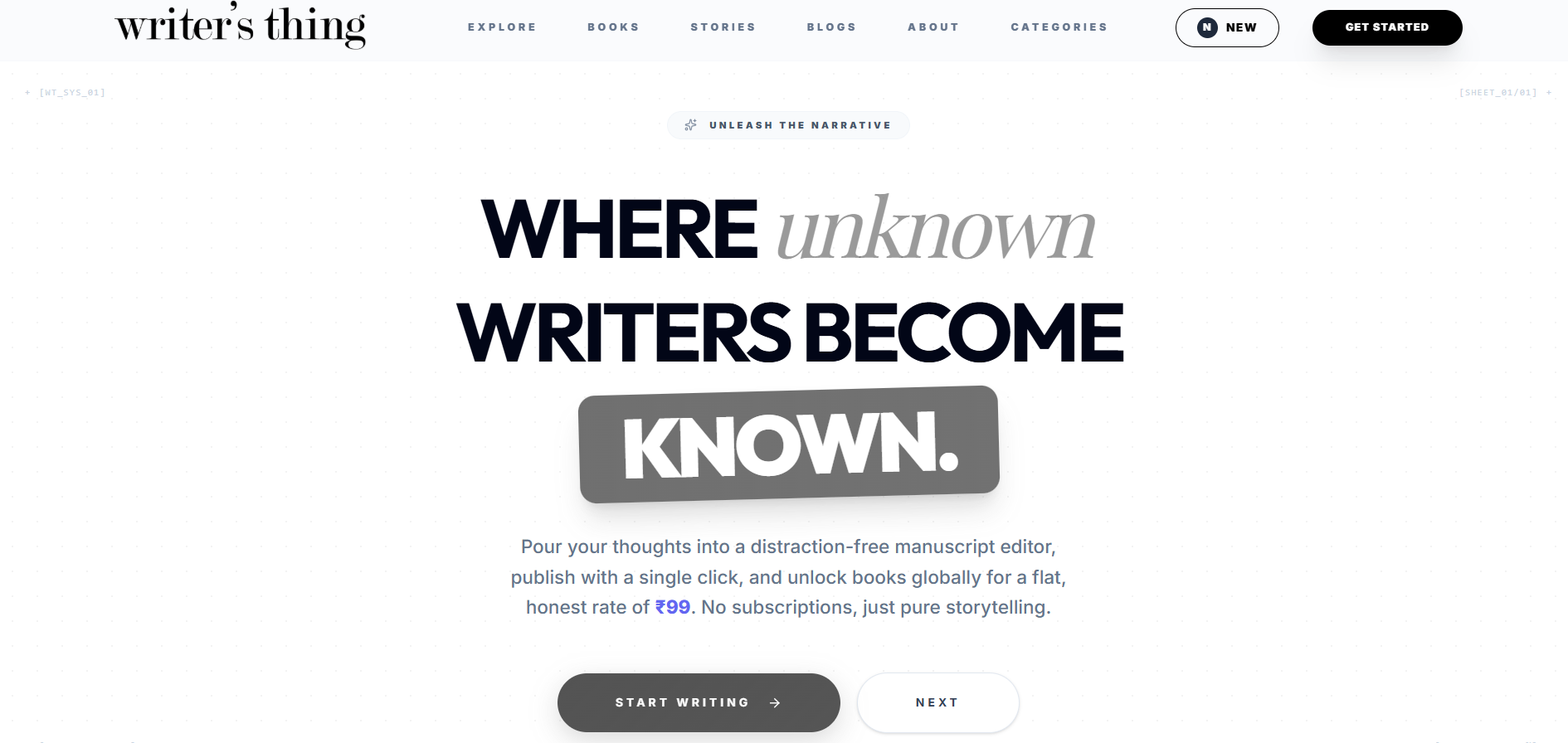
A modern publishing ecosystem built for writers and readers to publish, manage, and distribute digital books through an intuitive and scalable platform.
My Role
Product Engineer (End-to-End)
Team Size
Solo / AI-Assisted
Status
Beta / Launching Soon
Platform
Web Application (SaaS)
Executive Summary
Overview
Writersthing is a comprehensive SaaS platform designed to modernize the digital publishing ecosystem. It acts as a bridge between independent authors and avid readers, providing a unified space to write, edit, publish, and monetize digital literature.
Why it matters: By removing the technical and logistical barriers to self-publishing, Writersthing empowers creators to focus entirely on their craft while retaining ownership of their distribution channels and revenue streams.
Context
The Problem
Business Problem: Legacy publishing platforms take massive revenue cuts (often 30-70%) and offer opaque analytics, making it difficult for independent authors to build sustainable businesses.
User Problem: Authors face a steep learning curve when formatting manuscripts for various digital devices. Readers suffer from disjointed experiences, often having to download external e-reader apps to consume content purchased directly from creators.
Opportunity: To build a vertically integrated, premium publishing SaaS that offers a distraction-free writing environment, automated formatting, and integrated payments—allowing authors to capture higher margins with zero technical overhead.
Strategy & Solution
My Role
Architected and executed the entire platform from the ground up, including product strategy, UX/UI, Next.js frontend, Express API, Supabase architecture, and Stripe payments.
Product Vision
To become the default operating system for independent digital publishing, where the transition from drafting to monetization happens in a single click.
Information Architecture
The platform is bifurcated into the 'Creator Studio' for manuscript management and payouts, and the 'Reader Portal' for discovery and consumption.
Key UX Decisions
Prioritized a typography-first approach and a distraction-free mode where the editor and reader collapse all navigation elements when scrolling or typing.
Core Features
Unified Manuscript Editor
A rich-text, block-based editor optimized for long-form content. Eliminates the need to draft in Word and painfully format for the web later. Kept performant at 100k+ words via virtualization.
Frictionless E-Commerce
Integrated Stripe Connect to handle complex multi-party routing, ensuring authors receive payouts automatically while remaining compliant with international tax regulations.
Responsive Web Reader
A premium reading interface that adapts to any device, offering dark mode, font scaling, and bookmarking. Progress syncs accurately across all devices via the database.
Intelligent Features
AI Implementation
While Writersthing is fundamentally a SaaS platform rather than a pure AI product, strategic AI integrations enhance the author experience without compromising creative integrity.
- Automated Metadata Generation: Using OpenAI's LLMs to analyze manuscripts and suggest SEO-optimized titles, summaries, and genre tags to aid in discovery.
- Workflow: When an author moves to "Publish," a background job chunks the text and requests promotional blurbs. The author retains full editorial control to accept or modify suggestions.
- Guardrails: AI is strictly utilized as a suggestive tool for marketing and discovery, never autonomously altering the core manuscript, respecting the author's voice.
Trade-offs
Engineering Challenges
Handling Large Documents: Long manuscripts caused significant UI lag when typing. I adopted a block-based editor architecture and implemented virtualization for chapter management. While this increased initial development time compared to a standard textarea, the performance gain was mandatory for long-form writing.
Cross-Device Reading State: Readers expect to close a book on their laptop and open it on their phone exactly where they left off. I implemented a continuous sync mechanism that debounces the user's scroll position to PostgreSQL, ensuring a native-feeling experience.
Outcomes & Roadmap
Product Outcomes
Delivered a fully functional Beta platform that successfully manages the entire lifecycle of a digital book from draft to monetization.
Technical Outcomes
Architected a scalable database schema capable of handling high-volume read traffic and complex write operations, with seamless multi-party payment routing.
Future: Audiobook Integration
Implementing advanced Text-to-Speech (TTS) models to automatically generate high-fidelity audiobooks from written manuscripts.
Future: Offline Reading
Utilizing Progressive Web App (PWA) technologies and IndexedDB to allow readers to download books for offline consumption in the browser.
Key Takeaways
Reflection
Building a dual-sided platform is exponentially more complex than a single-user SaaS. You have to build two distinct products (the Creator Studio and the Reader Portal) that communicate flawlessly. I learned that prioritizing the reader's UX is actually the best way to serve the author, because a great reading experience drives sales.
Technology Stack
Frontend
Backend
Database & Auth
Payments & Cloud
Next Project
View Case Study